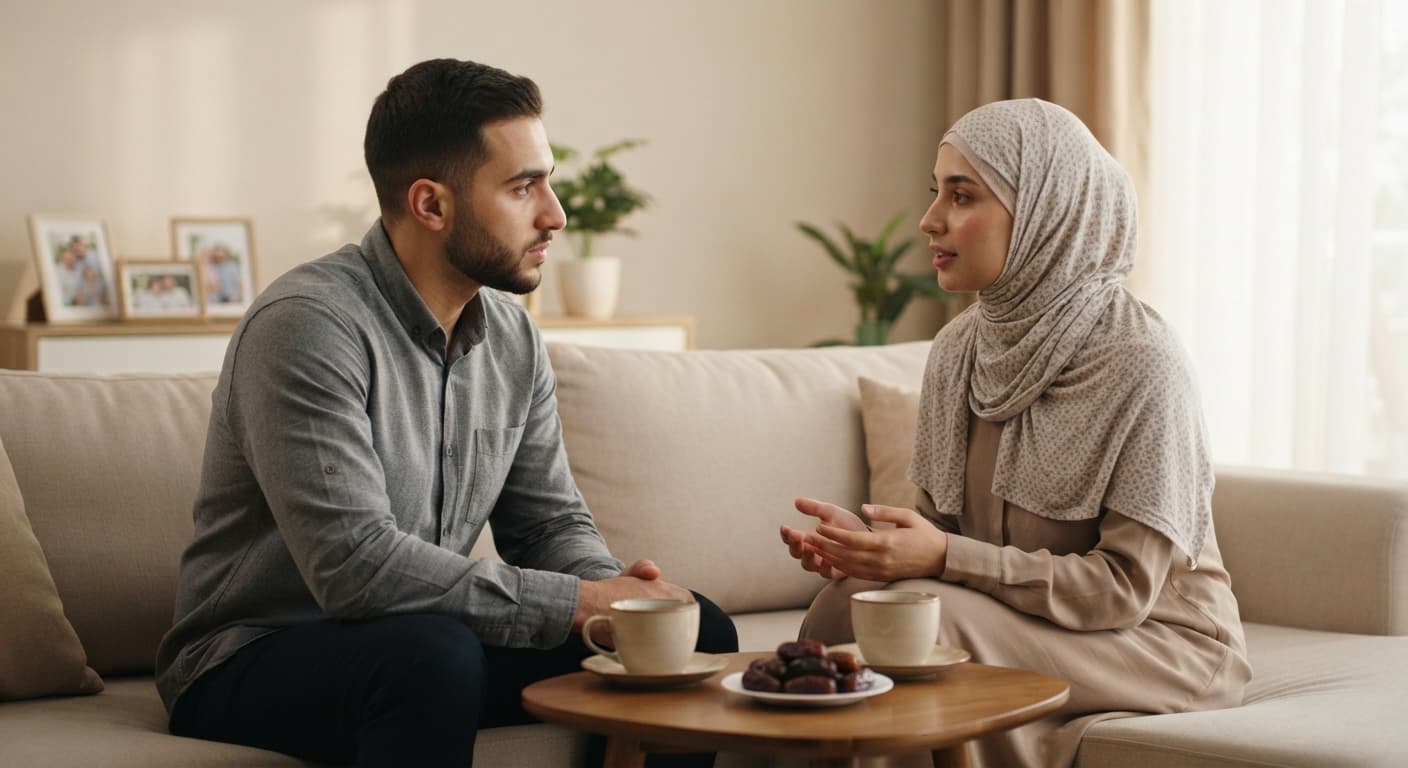
After the engagement is officially announced and congratulations pour in from everyone, a woman notices a strange, gradual shift in her fiancé's behavior: as if he feels the battle is won and the matter fully settled, his noticeable enthusiasm for daily contact and attention to small details, which had marked the getting-to-know-you period before engagement, starts to fade. There's nothing "bad" in any obvious sense, but she feels an uncomfortable coolness she hadn't expected at this specific stage, one she'd assumed would bring them closer, not further apart. She honestly wonders: is this decline normal after formal commitment, part of the relationship settling down, or a warning sign worth paying serious attention to?
The engagement period is fundamentally different from the getting-to-know-you stage that preceded it: it carries new religious guidelines, shared practical responsibilities toward wedding preparations, and greater involvement from both families. This fundamental difference means the standards for "health" at this stage differ slightly from the standards of the getting-to-know-you stage. So what practical signs indicate an engagement is heading in a healthy direction?
The shift from "we're getting to know each other" to "we're building together"
The first healthy sign is the relationship's feeling gradually shifting from "we're getting to know each other" to "we're building something together": jointly planning wedding details, making practical decisions together, thinking about the future as one unit rather than two separate parties negotiating. The absence of this shift, with the relationship staying stuck in the same "getting to know you" pattern with no development toward practical partnership despite the engagement moving through its various stages, is a sign worth calmly reflecting on.
Genuine involvement in practical decisions, not just for show
An important sign is feeling that your opinion is taken seriously in decisions related to the upcoming marriage, not just a formal consultation with the actual decision made independently of it. A fiancé who asks your opinion on every detail but moves forward with his own decision regardless of your answer is giving you only apparent involvement, not real involvement. Healthy involvement means your opinion changes the course of a decision sometimes, not that it's just heard out of courtesy before the decision gets made exactly as it was already planned to be.
Commitment to religious guidelines without it becoming a burden that suffocates the relationship
A healthy engagement finds balance between full commitment to the religious guidelines around meetings and contact, and building a warm, genuine relationship within that framework. When one side feels the guidelines are being used as an excuse to reduce actual contact rather than as a respectful framework for healthy communication, that deserves an honest conversation. Religious guidelines aren't an obstacle to building a genuine relationship — they're a framework that protects it; the problem only arises when they're misunderstood or used as an excuse to avoid caring about the other person.
Reaction to pressure from both families
The engagement period usually carries greater family involvement in many practical details, and that's natural and expected. The healthy sign is your fiancé standing with you as a partner when disagreements surface between your wishes and his family's, not always siding with his family with no attempt at balance or understanding your position. Someone who maintains a balanced stance, listening to and respecting their family without abandoning their future partner in every disagreement, shows genuine maturity worth noticing and appreciating.
The ability to step back if a flaw emerges, despite social progress
Engagement, despite being a stronger formal commitment than getting-to-know-you, isn't an irreversible final marriage. The healthy sign is both sides feeling they're still able to discuss any fundamental flaw that emerges, and even step back if it calls for that, without social embarrassment over canceling an engagement being a sufficient reason to continue a relationship that later turns out to be unsuitable. Fear of socially canceling an engagement shouldn't be stronger than the need to make the right decision, however socially difficult it is.
The level of honesty increases, rather than freezing or declining
As the engagement progresses, the level of honesty and openness between both sides is expected to gradually increase, not stay fixed at the same level as the early getting-to-know-you period, or decline. Engagement is an opportunity for deeper mutual knowledge, and it's natural for details never raised before to be discussed during it. The absence of this deepening, or noticing the other person becoming more reserved as time progresses instead of more open, deserves genuine reflection on exactly why this decline is happening.
Feeling like one team in front of both families
One of the beautiful, important signs is feeling, you and your fiancé together, like one team facing any external challenge, including any disagreement that might arise between the two families over preparation details. This doesn't mean blindly siding with each other with no objectivity, but it does mean final decisions get made between the two of you as one unit, not each side left negotiating alone with their own family with no real coordination with the other.
A warning sign: negative change in temperament after the commitment is confirmed
It's worth paying serious attention if you notice a clear negative change in your fiancé's temperament after the engagement is officially finalized, as if the formal commitment gave him a false sense that he now needs to put in less effort now that things are "settled." This pattern, when it clearly appears, is an important indicator of how he'll likely behave after marriage itself, when the commitment becomes far greater than engagement. Someone who puts in less effort after every new stage of commitment deserves to be honestly asked about this noticeable change before moving to a stage of far greater commitment.
The difference between exhaustion from preparations and exhaustion from the relationship itself
It's important to clearly distinguish between exhaustion caused by the pressure of wedding preparations themselves, which is natural and temporary and ends once this stage is over, and exhaustion caused by the relationship itself, which is deeper and more lasting and deserves different attention. An engaged couple tired from too many decisions and appointments but still understanding and supportive of each other amid this exhaustion is in a different situation than a couple feeling tired from communicating with each other, regardless of the surrounding pressure of external preparations.
Does this mean every detail needs to be perfect?
Of course not; the engagement period, however healthy, will carry some natural tension tied to the pressure of preparations, family involvement, and the sheer number of decisions required in a relatively short time. The fundamental difference isn't the absence of all tension, but both sides' ability to get through it together as one team, and return to a state of stability after each passing wave of pressure. Excessive worry over every minor disagreement, and searching for absolute perfection in every detail, turns watching for these signs into an additional source of stress instead of a useful tool for calm evaluation.
How do these signs differ depending on the engagement's length?
A short engagement lasting only a few weeks before marriage carries a different dynamic than one lasting a full year or more. In a short engagement, most energy gets consumed by urgent practical preparations, and that's natural and doesn't call for special worry as long as basic communication is still there. In a long engagement, gradual development in the relationship becomes more important, because the available time is enough to notice recurring patterns, and the absence of any noticeable development across many months carries a far stronger signal than the same absence might carry in a short engagement that never had enough time for these signs to clearly appear in the first place.
The role of talking to friends or relatives who went through the same experience
Sometimes it's hard for a person to evaluate their own relationship objectively enough while immersed in its daily details. Talking to a trusted person who went through a similar engagement, not to get a ready-made verdict but to hear your own thoughts spoken aloud and compare them to real experiences, helps a lot in seeing the picture more clearly. What if everything looks fine on the surface, but there's a vague inner discomfort you can't quite pin down? That feeling doesn't deserve to be dismissed just because every outward indicator looks good; sometimes intuition picks up on small, repeated details the conscious mind no longer registers separately, but that accumulate into a general feeling. The right move isn't ignoring that feeling, nor making a hasty decision based on it alone, but trying to identify it honestly, whether by writing it down or talking to someone you trust. It also helps to observe how your fiancé behaves in unplanned moments, away from the pre-arranged celebratory atmosphere, since these spontaneous situations reveal his real character more than any formal, pre-planned occasion. This doesn't mean every detail in this stage needs to be perfect — it means each person generally feels safe and clear about the overall direction the relationship is heading. How do these signs vary with how long the engagement lasts? A short engagement may not show all these signs clearly yet, and that alone doesn't call for premature, unjustified worry.
In the end
A healthy engagement period isn't free of challenges, but it's marked by clear practical signs: a gradual shift toward genuine partnership, real involvement in decisions, a healthy balance between religious guidelines and emotional closeness, and a balanced stance in the face of family pressure. Whoever learns to read these signs consciously during engagement enters marriage with far greater confidence in the foundation of their relationship, because that genuine confidence was built on actual, repeated observation, not on a vague general hope that everything will automatically get better after the wedding day with no conscious effort from either side. Engagement, at its core, is a small-scale practical test of what marriage will look like, and whoever reads it honestly enters the next stage with their eyes fully open.
Put your standards in a real profile
Create your free account in the browser and let matching work on your criteria, not on photos.