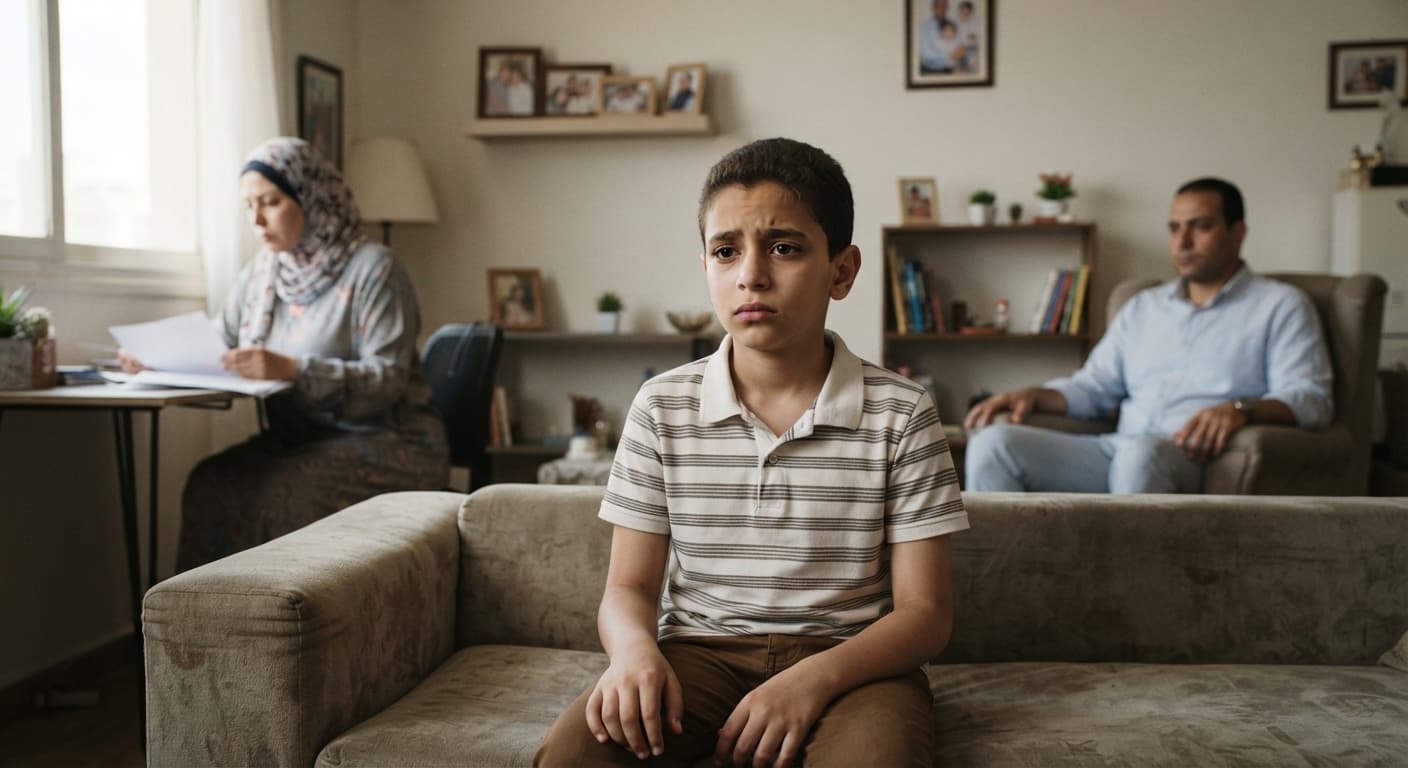
A father notices his seven-year-old daughter has started apologizing excessively over trivial things that don't deserve any apology at all, just a few weeks after his official separation from her mother: she spills a small drop of water and apologizes in a trembling voice as if she'd committed a huge mistake, or forgets a small toy in the wrong spot and starts crying hard, out of proportion to the situation. This new behavior worries him a great deal, and he later discovers, after research and specialized counseling, that this specific behavior is a very common sign among many children going through their parents' separation, tied to a hidden, deep feeling of guilt about the divorce itself, even though they have nothing to do with it.
Divorce's impact on children is real and significant, but it's far more complex than many parents imagine, and it's affected by many factors that go beyond the mere occurrence of the separation itself. So what determines the scale of this impact, and what can parents do to minimize it as much as possible?
Children don't express being affected the same way adults do
Unlike adults, who can usually express their feelings in direct words, children, especially young ones, express being affected by divorce through indirect behaviors that parents might not easily connect to the separation itself: a sudden decline in academic performance, disturbances in sleep or eating, unusual aggression toward siblings or friends, or even the regression of already-acquired skills, like nighttime bladder control in young children. Noticing these indirect signs, and connecting them to the separation event instead of considering them just a "passing phase" unrelated to it, is a necessary first step in understanding the true scale of a child's distress.
Guilt: the most common reaction, and the least visible on the surface
Many children, especially at preschool age and the early school years, naturally tend, due to their developmental way of thinking, to consider themselves the center of everything happening around them, including their parents' separation. A child might believe, without saying it outright, that their bad behavior on a certain occasion, or even their mere existence, was a cause of the disagreement that led to the separation. This feeling of guilt, despite not being fully logical from an adult's perspective, is very real for the child, and deserves explicit, repeated reassurance from both parents that the separation is a decision made by the adults alone, and has nothing to do with anything the child did or didn't do at all.
A child's age changes how they're affected and how they understand the situation
Very young children, roughly under age five, are often affected more by the change in routine and immediate stability than by any full understanding of what "divorce" itself means. Elementary school children start to have a deeper understanding of the situation, making them more prone to feeling guilty or trying to "fix" the relationship between their parents in various ways. Teenagers, on the other hand, might show more direct anger, social withdrawal, or even an accelerated push toward personal independence as an unconscious reaction to losing their usual family stability. Understanding these age differences helps parents tailor how they handle each child according to their own developmental stage.
Ongoing conflict after separation is more harmful than the separation itself
One of the most important findings repeated in specialized research in this field is that ongoing, visible conflict between parents after separation, not the separation itself, is what leaves the biggest, deepest mark on children in the long run. Children whose parents are separated but cooperate calmly and with mutual respect are often in a far better state than children whose parents are officially married but live in constant, visible conflict in front of them. This finding, however hard to accept sometimes, carries a hopeful message: the greatest harm isn't inevitable just because a divorce happened — it depends heavily on how the relationship between the parents is managed afterward.
Routine stability as a fundamental psychological protective factor
Children, especially young ones, draw a great deal of their sense of safety from the stability of their daily routine: bedtime and mealtimes, school, familiar activities. Maintaining as much of this stability as possible during and after the separation, despite all the other major changes the child is going through, gives them a kind of stable psychological ground amid the larger storm of change surrounding them, and helps them adapt far better gradually than a child facing multiple radical changes all at once across every aspect of their life.
Avoiding using the child as a messenger or a pressure tool against the other parent
One of the most damaging, and unfortunately one of the most common, mistakes is using the child as a means of passing angry messages between parents, asking them to choose one parent over the other, or even just speaking negatively about the other parent directly or indirectly in front of them. This pattern puts the child in an impossible, psychologically painful loyalty conflict, and burdens them with far more emotional weight than they can handle at their age, regardless of how legitimate a parent feels their anger toward the other parent to be. Protecting the child from this conflict between adults is every parent's responsibility toward their child, regardless of any personal disagreements between the parents themselves.
Talking honestly in an age-appropriate way — neither silence nor excessive detail
Complete silence about the reason for the divorce leaves the child imagining their own explanations, often worse than the truth itself, while sharing excessive, unnecessary detail, especially details tied to one parent's personal mistakes, burdens the child with information they don't need and can't process in a healthy way at their age. The right balance lies in an honest, simplified conversation appropriate to the child's age: "mom and dad decided we're not going to live together anymore, but we both still love you very much and that's never going to change," without going into the details of the disagreement itself or trying to win the child's sympathy against the other parent in any way.
Maintaining the child's relationship with both parents without favoritism
Unless there are serious reasons requiring otherwise, like a real threat to the child's safety, children usually benefit from maintaining a healthy, regular relationship with both parents after separation, not just one. This requires genuine cooperation from the parents, even if they feel personal bitterness toward each other, because the child's need for a stable relationship with both of them deserves to outweigh any personal disagreement between them as former spouses — not as parents who continue sharing responsibility toward this child.
Signs that deserve specialized support for the child
When signs of negative impact continue, like severe social withdrawal, a sharp and ongoing decline in academic performance, or recurring aggressive behavior, for a period extending beyond a few months after the separation without noticeable improvement, it's worth seeking specialized support from a child therapist experienced in dealing with children's experiences of parental separation. This early support can prevent psychological effects from worsening into ones that might last many long years if left unaddressed at their appropriate early stage.
Appropriate timing for disclosure: why there's no completely pain-free "perfect moment"
Many parents search for the "perfect timing" to tell their children about the separation decision, believing that choosing exactly the right moment will reduce the pain. The truth is there's no timing free of pain for news this significant, but there are useful general principles: telling the children together as a united front of parents as much as possible, rather than each parent telling their own separate version of the story, and choosing a time followed by enough of a stable parental presence to emotionally support the child, not telling them and then immediately disappearing for urgent practical matters, leaving the child alone with the shock of the news.
Keeping positive memories of the previous family, not erasing them entirely
Some parents, driven by their own personal pain from the separation, tend to erase every trace of the previous family life: removing shared photos, avoiding any mention of beautiful memories that brought the family together; this deprives the child of holding onto positive memories that were an important part of their early childhood, and letting them keep those memories without forcing a choice between "the past" and "the present" helps them build a complete, healthy narrative about their life. Is hiding sharp conflict from the children completely always the safest approach? Not necessarily — hiding all tension can leave children without an understandable explanation for clear changes they notice at home, so they build their own explanations, which can be worse than the truth, like assuming they're the cause. It's better to offer a simple, age-appropriate explanation without painful details, with a clear, repeated reassurance it has nothing to do with them. It also helps to keep some consistency in children's daily routine despite all the surrounding change, since stability in small details gives them a sense of safety amid a bigger change they can't fully process yet. Stability in small details, like bedtimes and school schedules, gives children a sense of safety amid a bigger change they can't fully process yet, and that alone deserves daily care from both parents despite whatever personal pressure they're going through. However hard this stage is on the parents, the child's sense of safety and stability remains the most important measure of how well it's handled.
In the end
Divorce's impact on children is real, but it isn't inevitably as severe in every case; it depends heavily on how the parents manage the period following the separation: maintaining routine stability, avoiding visible conflict in front of the child, balanced honesty without excessive detail, and maintaining a healthy relationship with both parents. Parents who put their children's needs above their personal bitterness toward each other give their children a genuine chance to adapt in a healthy way to a major change in their lives, and to build, later on, a balanced understanding of what family means, even in its new form, different from what they once expected.
Put your standards in a real profile
Create your free account in the browser and let matching work on your criteria, not on photos.