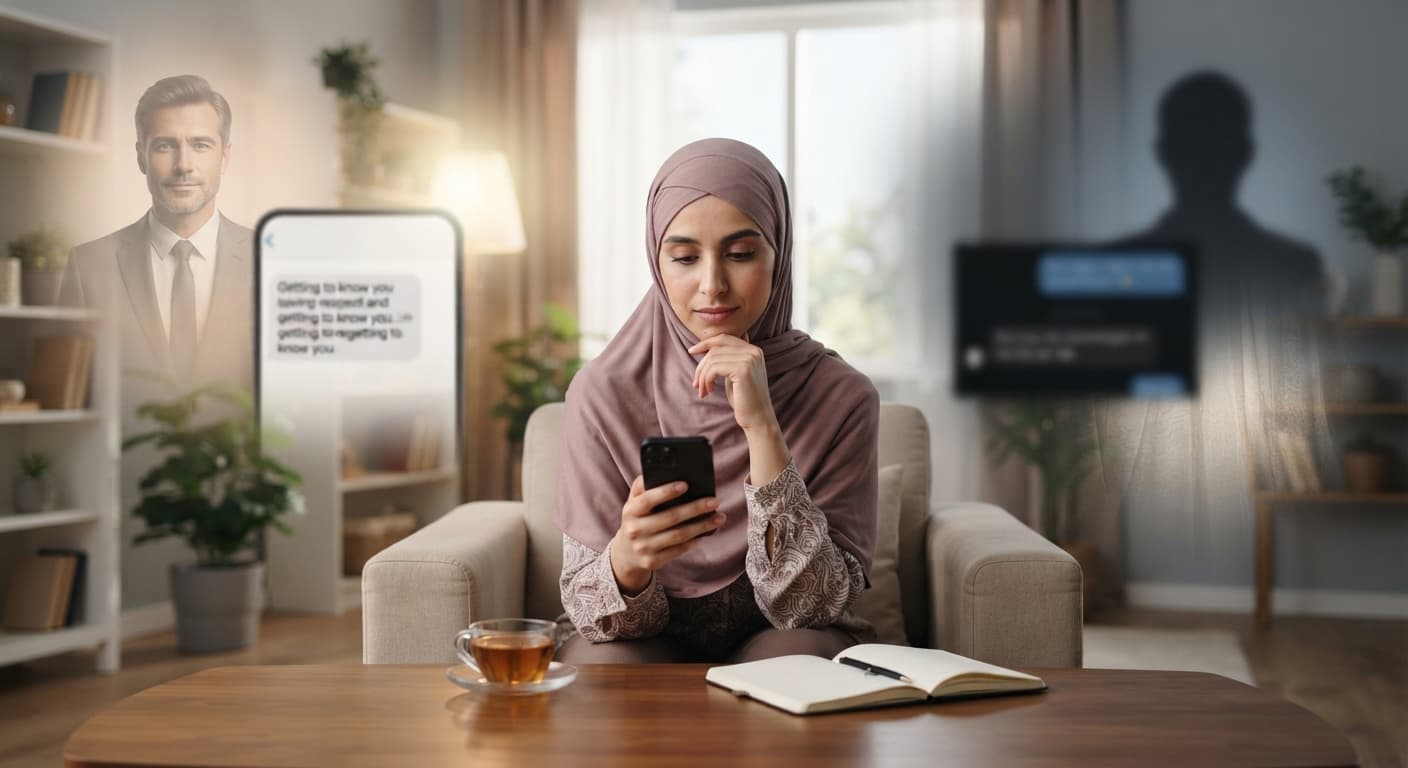
Getting to know people online — what's usually called the talking stage — has become a common way to meet new people, and it can be a suitable, serious path for someone looking for a life partner, especially when the goal is clear from the start.
But getting to know someone online is different from meeting in person; at first, you're dealing with information, photos, and conversations that may not give you the full picture of the person. That's why it needs awareness and a level head, so the desire to connect doesn't turn into rushed decisions or unrealistic expectations.
If the goal is marriage, what matters isn't just starting a good conversation — it's using this period to build a clear, balanced picture of how compatible you really are.
1. Rushing to Build Trust
One of the most common mistakes is feeling, after a very short time, that you already know the other person well.
Conversations can be long and enjoyable, but that doesn't necessarily mean you know how the person behaves in different situations.
Trust needs time and a range of situations, not a large number of messages.
So don't make big decisions based on the first impression alone.
2. Relying on the Photo Alone
A photo is part of getting to know someone, but it doesn't reveal their character, way of thinking, or values.
A photo can be attractive without there being any real compatibility in personality or goals.
On the other hand, a plain photo might not reflect all of a person's good qualities either.
If the goal is marriage, focus on character, values, and how they think, alongside looks and appearance.
3. Building an Idealized Image Through Conversation
It's easy to build an idealized picture of someone in your mind based on what they say.
The more kindly they talk to you, the more you might start imagining their life and character the way you wish it to be.
But you need to tell the difference between:
what you actually know about the person
and
what you're imagining about them.
Don't fill in the gaps with your own assumptions.
4. Sharing Personal Information Too Quickly
Getting to know someone doesn't mean revealing every detail of your life from day one.
Avoid sharing sensitive information like:
- Passwords.
- Verification codes.
- Bank details.
- Personal documents.
- Your detailed address.
- Information that could be used to access your accounts.
- Private photos you wouldn't want spreading.
Share information gradually, at a pace that fits the stage you're at.
5. Sending Private Photos
If the other person asks for a personal or private photo and you're not comfortable, don't feel obligated to agree.
Even if the conversation seems serious, you can't fully control what happens to the photo once it's sent.
If the platform has an official system for photo requests, it's better to use that instead of sending photos directly.
6. Moving Off the Platform Too Quickly
The other person might ask for your phone number or another app's contact shortly after you start talking.
That's not necessarily dangerous, but nothing forces you to move quickly.
Use the platform's own communication tools until moving elsewhere feels right, and don't share personal details just out of fear of losing them.
7. Ignoring Warning Signs
An uncomfortable behavior sometimes shows up early on, but gets ignored because you're drawn to the other person.
Signs worth paying attention to:
- Repeated lying or inconsistency.
- Constant pressure.
- Not respecting boundaries.
- Asking for money.
- Asking for sensitive information.
- Getting angry at being declined.
- Trying to control your decisions.
- Pushing the relationship forward too fast.
- Threats or blackmail.
Don't ignore troubling behavior just because the rest of the conversation is good.
8. Getting Attached Before Knowing How Compatible You Are
Daily, ongoing contact can easily lead to emotional attachment.
After a while, a person might become attached to the relationship before even knowing whether the other person is right for marriage.
Try to make this period a way to understand compatibility, not just a source of feelings.
Ask yourself:
"Are we actually compatible?"
not just:
"Am I attached to this person?"
9. Avoiding the Important Questions
Some people prefer talking only about hobbies and fun things, avoiding serious topics so the conversation doesn't feel heavy.
But if the goal is marriage, there are important things that need discussing at the right time.
Such as:
- Marriage goals.
- Values and principles.
- Responsibilities.
- Work.
- Money.
- Children.
- Relationship with family.
- Where to live.
- Lifestyle.
- How to handle disagreements.
You don't need to ask everything in the first conversation, but don't let fear of a serious talk stop you from learning the essentials.
10. Turning It Into an Interrogation
On the other hand, don't turn it into a long chain of questions as if the other person were in a job interview.
Getting to know someone needs a two-way conversation.
Ask, listen, and share about yourself too.
Watch not just their answers, but how they think while talking.
Do they listen?
Do they respect your differences?
Can they discuss things without getting angry?
These things can matter more than some of the answers themselves.
11. Trying to Change the Other Person
It's a mistake to go into this thinking:
"I'll get them to change after we're married."
If there's a fundamental difference in personality or values, don't rely on the idea that marriage will automatically change someone.
Get to know the person as they are now, then ask yourself whether you can accept them with these traits or not.
12. Constantly Comparing Them to Others
Getting to know people online can expose you to a lot of people, which can create a feeling that there's always a better option out there.
You might start comparing everyone by looks, job, or how they talk.
But marriage isn't a contest to pick the person with the most checked boxes.
Look for real compatibility instead of constantly searching for the perfect person.
13. Ignoring a Difference in Values Because of Attraction
There can be strong attraction between two people, but it doesn't make up for fundamental differences.
If there are fundamental differences in religion, values, or how each of you sees marriage and family, they shouldn't be ignored just because of strong feelings.
Attraction matters, but it isn't, on its own, enough of a basis for deciding to marry.
14. Sending Money to the Other Person
A request for money during online getting-to-know-you calls for serious caution.
Don't let feelings be the reason you send money or share financial details.
If the person keeps asking for money, uses moving stories to pressure you, or treats your financial help as a test of your love or seriousness, stop and reassess the relationship.
15. Believing Everything Without Verifying
Getting to know someone online initially relies on the information they give you about themselves.
So it's natural that some important information will need verifying once the relationship reaches a more serious stage.
Especially things that will directly affect the decision to marry.
Trust doesn't mean switching off your judgment or ignoring facts.
16. Confusing Privacy With Secrecy
It's natural for everyone to have their own privacy.
But there's a difference between keeping personal space and hiding essential information that affects the decision to marry.
If there's something essential the other person should know before an important decision, it shouldn't be hidden until the last moment.
17. Ignoring How the Person Handles Being Told No
One of the best ways to learn someone's character is to notice how they handle the word:
No.
If you decline a request, do they respect your decision?
Or do they start pressuring you?
Can they accept a difference of opinion?
Or do they try to make you feel guilty?
How they handle boundaries reveals a lot about the nature of the relationship.
18. Talking All Day, Every Day
A lot of communication isn't necessarily a sign that things are going well.
Constant talking can become a habit that attaches you to the conversation itself more than to actually learning about real compatibility.
Leave room for real life — work, family, worship, hobbies, and responsibilities.
Balance is better than nonstop contact.
19. Ignoring Real Life
Messaging alone isn't enough to base a decision to marry on.
As things get serious, the relationship needs to gradually move toward real, appropriate steps, in line with both people's values and boundaries.
The goal is to get to know the person in different contexts, not just through messages.
20. Deciding to Marry Under Time Pressure
A person might feel they need to decide quickly so they don't lose the other person.
But marriage is a major decision — it shouldn't turn into a race.
Take enough time to think, discuss the essentials, and consult people you trust when it's appropriate.
A calm decision beats a rushed one you'll regret later.
21. Ignoring Your Own Discomfort
Not every feeling of discomfort means there's a real problem, but it deserves attention.
If you keep feeling that something's off, don't ignore it just because the relationship looks fine from the outside.
Try to pin down the reason.
Is there a contradiction?
Is there pressure?
Are your boundaries being crossed?
Do you not feel safe?
Pinpointing the reason for your discomfort can sometimes help you reach a clearer decision.
22. Believing a Successful Getting-to-Know-You Must End in Marriage
This is a very important idea.
Getting to know someone isn't a promise of marriage.
Two people can get to know each other and then discover the compatibility isn't enough.
That's not a failure.
In fact, discovering incompatibility during this period is far better than discovering it after marriage.
The goal is to reach a conscious decision, whether that means continuing or withdrawing respectfully.
How Do You Make Online Getting-to-Know-You More Mature?
It can be summed up in a simple set of rules:
Be honest, but don't reveal everything too fast.
Be open, but protect your privacy.
Build trust gradually, and don't assume it from the first conversation.
Listen to what's said, but watch the behavior too.
Discuss important things at the right time.
Respect the other person's boundaries, and hold on to your own.
Don't let feelings stop you from seeing reality.
And don't decide to marry before you truly know the person.
In the End
Getting to know someone online can be a good start to a serious relationship, but it needs awareness and balance.
Don't rush into trust, don't build an idealized picture of someone from messages alone, don't share private information under pressure, and don't ignore signs that make you uncomfortable.
At the same time, don't let caution stop you from a natural getting-to-know-you process and honest conversation.
Good getting-to-know-you isn't about the hours you spend talking — it's about how much that talk genuinely helps you understand each other, discover your real compatibility, and make a conscious, respectful decision about the future.
Put your standards in a real profile
Create your free account in the browser and let matching work on your criteria, not on photos.