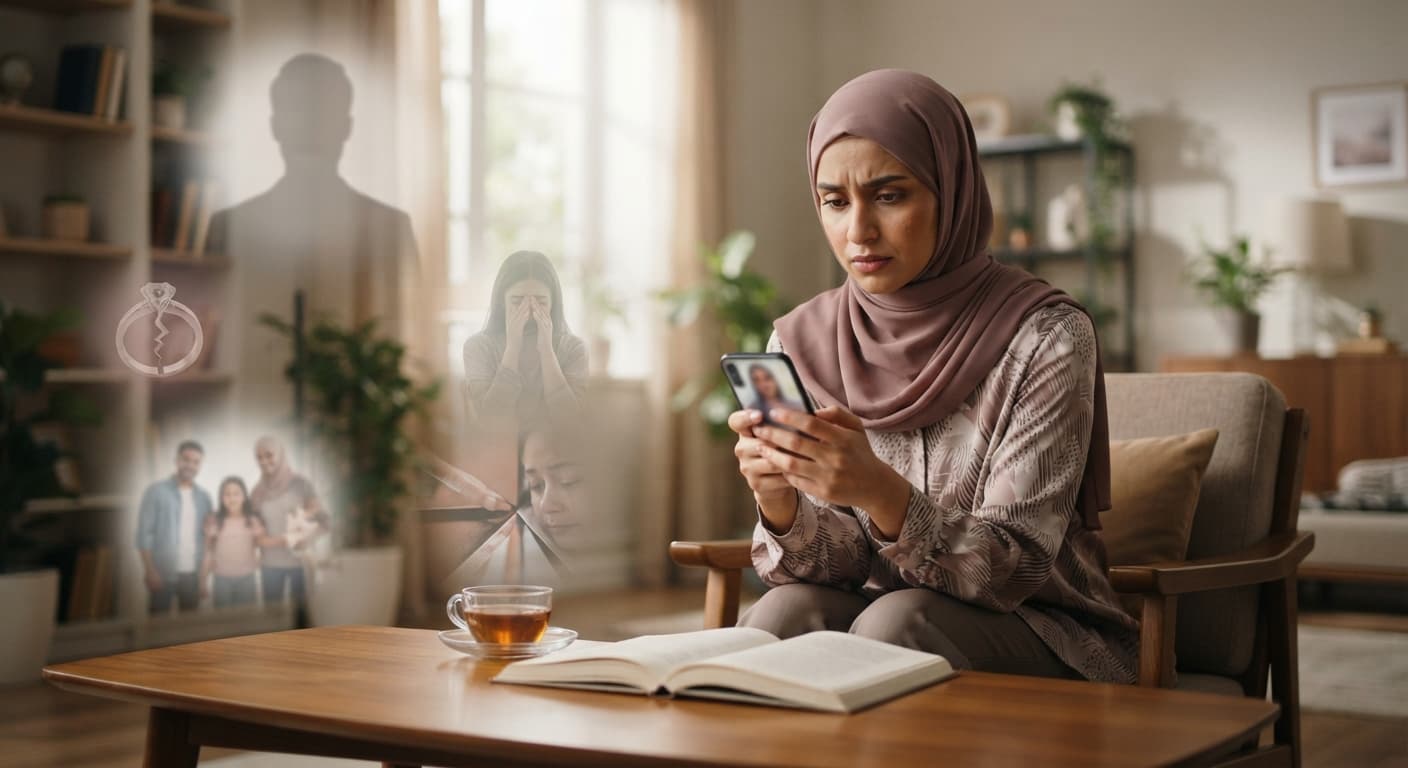
After three of her very close friends go through relatively sudden, painful divorces in nearly the same year, a woman married for two years, in a stable, happy relationship by every visible measure, finds herself, without meaning to at all, looking at her own relationship with growing suspicion, anxiously searching for "warning signs" similar to what her friends went through, despite there being no actual evidence of any similar problem in her own specific relationship. She later realizes, after honest reflection, that her mind had started unconsciously, automatically linking the idea of "marriage" in general with these three painful stories so close to her, even though the circumstances of each story were different from her own actual circumstances.
Other people's experiences, especially those emotionally close to us, shape our view of marriage far more deeply than we usually realize, sometimes in useful ways carrying genuine lessons worth attention, and other times in misleading ways that project anxiety that has nothing to do with our own reality. So how do these effects happen, and how do we distinguish between the two kinds?
Why do other people's experiences affect us this deeply?
Humans are naturally social beings who learn a large part of their understanding of the world by observing the experiences of those around them, not just from their own direct personal experience. This psychological mechanism is very useful in many contexts, because it allows learning from others' mistakes without needing to personally experience them. But it becomes a problem when applied uncritically, projecting another person's experience wholesale onto a different reality, without enough distinction between what's a useful general lesson and what's a detail very specific to that particular case.
Availability bias: when nearby stories become more influential than statistics
Behavioral psychology recognizes a phenomenon called "availability bias": the mind's tendency to give far greater weight to information easily available in memory, like stories of nearby people we know personally, compared to broader statistical information more representative of the general reality but less emotionally present in the mind. Three emotionally close divorce cases leave a far deeper psychological mark than reading a statistic saying most marriages in reality succeed and last, even though the statistic represents actual reality far more accurately than three individual cases, however emotionally close they are.
Parents' experience specifically: the deepest, longest-lasting effect
Among all influential experiences of others, a parent's marriage carries a deeper, more long-lasting psychological weight than any other experience, because it's the closest witnessed and the longest exposure throughout the formative childhood and teenage years that shape a person's basic understanding of what marriage and relationships mean in general. Someone who witnessed an unhappy parental marriage full of ongoing conflict often carries deeper expectations and caution toward the idea of marriage itself, even if that experience doesn't represent what might happen in their own relationship, different in its details and circumstances.
When a friend's story turns into a lens through which every other relationship is seen
Sometimes a close friend's experience going through a certain painful situation, like infidelity or ongoing emotional neglect, becomes an unconscious lens through which every other relationship gets seen afterward, including the person's own relationship, even in the absence of any actual evidence of a similar problem. This effect, while unintentional, can create unwarranted anxiety and suspicion in a healthy relationship, or even push toward unnecessary defensive behaviors based on fears borrowed from someone else's experience, one fundamentally different in its core.
The difference between learned caution and projected anxiety
Caution learned from others' experiences is useful when it leads to deeper awareness of genuine, general warning signs worth attention in any relationship, like the importance of honest communication or the danger of ignoring recurring disagreements. Projected anxiety, in contrast, carries details very specific to another person's experience, like the nature of the specific person who betrayed them or their very particular circumstances, and projects them onto a different person or situation with no real logical justification for that projection.
The equally strong effect of overly idealized success stories
It isn't only other people's negative experiences that are influential; overly perfect success stories, perhaps embellished deliberately or unintentionally by whoever's telling them, also create unrealistic expectations about exactly what a "successful marriage" should look like, making any real marriage, with all its naturally expected challenges, seem lacking compared to this ideal image drawn from someone else's experience whose full real details we don't know.
How do you tell a useful general lesson apart from a detail specific to that particular experience?
A useful practical question when affected by someone else's experience: is the lesson learned a general principle applying to any relationship, like the importance of honesty or the danger of ignoring accumulated problems, or is it a detail very specific to that particular case's circumstances that doesn't necessarily apply to my different circumstances? Do I have actual evidence of a similar problem in my own relationship, or is my anxiety just an unwarranted projection of someone else's experience onto myself?
The effect of repeatedly hearing one story from multiple sources
Repeatedly hearing the same kind of negative story from multiple sources, even if they're separate, unrelated cases, creates an inflated feeling that this kind of problem is far more common than it is in the broader reality. This perceptual inflation, resulting from repeated hearing rather than repeated actual occurrence, deserves special awareness, especially in an era where stories spread very quickly through social media and repeated daily conversations.
How do you protect your own view without denying others' useful lessons?
The healthy solution isn't ignoring others' experiences, since that loses you useful real lessons — it's developing the ability to consciously distinguish between the generalizable lesson and the detail very specific to that particular experience. Honestly asking yourself, after every story that affects you emotionally, about the actual evidence present in your own relationship, instead of settling for the general feeling generated by someone else's story, is a very important practical step to protect your own realistic view.
When do these effects deserve conscious review?
When you notice your anxiety or caution toward your own relationship has noticeably risen following hearing someone else's story, with no actual change in your own relationship justifying that rise, it's worth a conscious pause to honestly examine the source of this anxiety: is it built on an actual real observation in my relationship, or just an emotional echo of someone else's experience I've unintentionally projected onto my different reality?
The role of timing: a recent experience affects us more than an old one
A negative story heard recently carries a far greater psychological effect than a similar story heard many years ago, even if the second one was originally closer emotionally. This timing effect, known in behavioral psychology as the "recency" effect, partly explains why our general feeling toward the idea of marriage might noticeably shift during certain periods more than others, without there being any actual change in the real success rate of marriages in the broader reality around us — just a change in the relatively recent stories that have reached us lately.
An honest conversation with yourself that separates your experience from someone else's
A simple, very useful exercise when you feel clearly affected by someone else's experience is to honestly write down every actual point of similarity and every real point of difference between that experience and your own reality: are the circumstances similar? Are the people involved similar in their core nature? Are the timeframe and social context matching? Most of the time, this simple exercise reveals many fundamental differences that were hidden under the weight of the initial emotional impact, helping put things back into much clearer perspective.
The role of who we choose to consult: an indirect effect worth noting
Even the choice of who we turn to for advice before or during thinking about marriage carries a similarly hidden effect; a friend who recently went through a negative experience might advise, with good intentions, exaggerated caution stemming more from her own experience than an objective assessment of your situation. Diversifying your sources of advice helps get a more balanced, realistic picture. How does someone tell the difference between healthily learning from others' experiences and being excessively negatively affected by them? The difference lies in how you handle the story you hear: healthy learning means extracting a general, applicable lesson, like the importance of early honesty, without assuming your own experience will necessarily follow the same path; excessive negative influence means projecting someone else's experience entirely onto your own situation, as if the circumstances and people were exactly identical. It also helps to remember that everyone's experience is shaped by unique circumstances hard to replicate in detail, so even the closest-sounding story to your own situation won't match it exactly — a good reminder that your final decision should rest on your own circumstances, not anyone else's, however similar the two experiences seem. Whoever understands this difference can benefit from the wisdom of those who came before them without letting their fears or disappointments become a ready-made map for their own specific future, since every person's experience, however similar it looks on the surface, remains at its core unique and deserves to be measured by its own standard.
In the end
Other people's experiences, especially those emotionally close to us, form a real, natural part of our understanding of marriage and relationships, and can't and shouldn't be ignored. But awareness of how they affect us, and honestly distinguishing between the useful general lesson and unwarranted projected anxiety, protects against projecting fears or expectations that have nothing to do with our own reality onto a relationship that might be healthy, if not for this outside influence never honestly examined.
Put your standards in a real profile
Create your free account in the browser and let matching work on your criteria, not on photos.