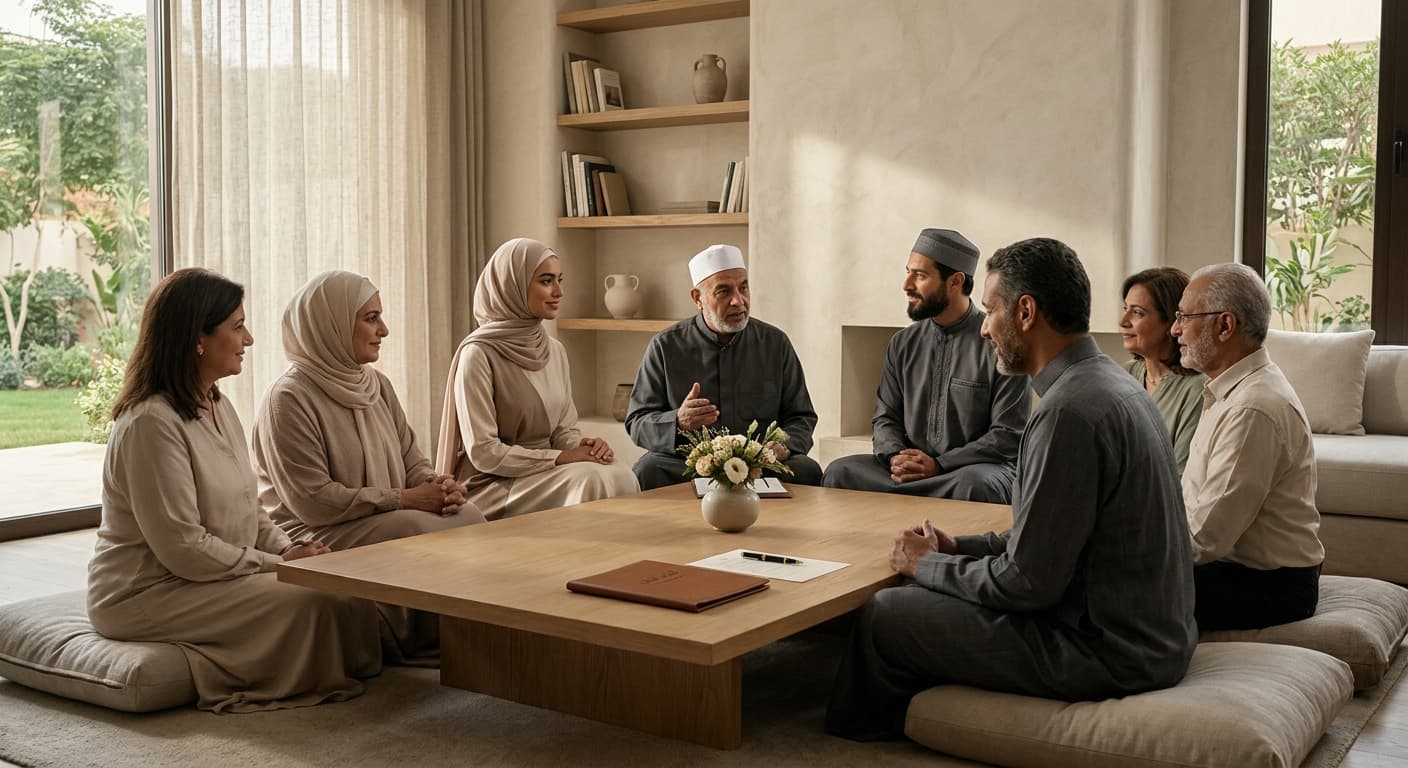
This happens to a lot of people: a simple family gathering, the imam asks the two of them two short questions, each responds with a word or two, everyone claps, and the whole thing is over in under ten minutes. A week later, someone asks: "Wait, are we actually officially married now, or do we still need to do something else?"
This confusion is extremely common, and it comes from mixing up two genuinely different things: the religious contract itself, and its government registration. The first is what makes you spouses before Allah and the religion; the second is a necessary administrative step that protects your legal rights, but it doesn't replace the first or substitute for it. To really understand the difference, you need to know what makes that short gathering religiously valid in the first place.
The two words everything revolves around
At the heart of the marriage contract is one simple moment: the woman's guardian (or someone acting on her behalf) says something to the effect of "I marry my daughter to you," and the groom responds with something to the effect of "I accept this marriage." There's no single required exact wording, but the phrase must be unambiguous, and the offer and acceptance must happen in one continuous sitting — not one person saying their part today and the other a week later.
That exact moment is what happened at that short family gathering. If it happened with its conditions met, the contract has genuinely taken effect religiously, regardless of any paperwork not yet signed.
Why isn't the contract valid without the guardian?
You might wonder: why isn't it enough for the two people to simply say their words to each other, without needing a third party to act on the woman's behalf?
The wisdom here isn't about diminishing the woman or her decision — it's about protecting her within a framework that makes marriage something announced and accountable, not a private arrangement that could be entered into impulsively or under pressure. The guardian is usually the father; if unavailable, the nearest male relative in a well-established order. His role here isn't a formality or a barrier to the woman's wishes — it's a genuine condition for the contract's validity itself.
And why two witnesses specifically?
Here's a point that might sound like a technicality but is actually fundamental: two witnesses must be present at the contract. The wisdom behind this is that marriage in Islam is a publicly announced contract, not a secret arrangement between two people. Imagine, for a moment, a marriage contract that happened with absolutely no witness at all — how could either person prove it later if the other denied it? The presence of witnesses is exactly what gives the contract its public, verifiable nature from its very first moment.
What about the mahr? Wasn't that mentioned in that gathering too?
You may have noticed that the simple contract session also included mentioning a specific amount, even if symbolic. That's the mahr — the wife's right, which must be agreed upon as part of the contract itself. Islam doesn't require a specific amount; what matters is that it's clearly specified and known to both sides, not left vague as "we'll sort it out later," because that exact vagueness is what opens the door to disputes down the line. If you want a deeper look at the meaning and wisdom behind the mahr, we've dedicated a full article to it.
So why does it need official registration too, then?
This brings us back to where we started. If the contract already took effect religiously, with all its pillars, in that gathering — why are you asked to go to a government office afterward to register it?
The answer is that the religious pillars make the contract valid before Allah and the religion, but they don't, on their own, grant it legal protection before the state: establishing parentage, inheritance rights, financial support, or even proving the marriage happened at all if either of you needs to do so officially in some future situation. Government registration isn't an extra "religious pillar," but it is a practical step that shouldn't be overlooked or postponed for long — its absence can turn a simple situation into a complicated legal problem later, especially the longer the gap grows between the religious contract and its official registration.
And why was it an "imam" who conducted the contract in the first place — is that a requirement?
Another question that comes up often: does the contract have to be conducted by a specific, officially appointed imam or religious figure? The answer, contrary to what many assume, is that the requirement isn't about the person's official religious title — it's about the pillars themselves, described above. In practice, someone with sufficient knowledge of the contract's wording and conditions is usually brought in, to make sure every pillar is properly fulfilled — not because their personal presence is a separate religious requirement on its own. That distinction sounds subtle, but it explains why a valid contract can happen abroad or in unusual circumstances without an officially appointed religious figure in the conventional sense, as long as the four pillars are genuinely met.
So, in short
If someone asks you again, "are you officially married?" after a simple contract session like that one, the religious answer is clear: yes, if the four pillars were met — clear offer and acceptance in one sitting, the guardian's presence, two witnesses, and an agreed mahr. But don't put off official registration for too long afterward — it's what legally protects this marriage in any situation where you might need to prove it later.
Further reading
Put your standards in a real profile
Create your free account in the browser and let matching work on your criteria, not on photos.