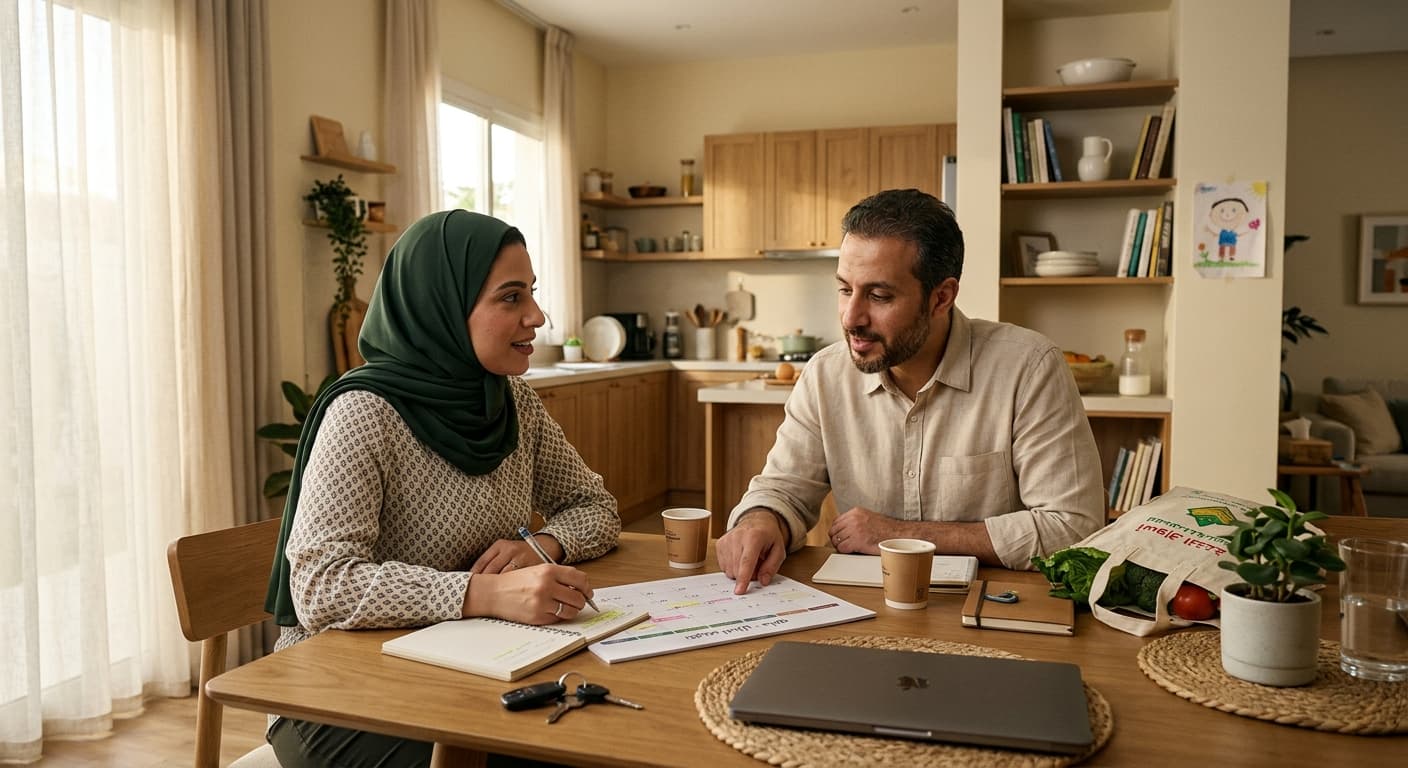
A successful marriage doesn't mean the couple never disagrees, or that every day is calm and perfect. Marriage brings together two different people — different personalities, experiences, ways of thinking, and needs — so it's natural for differences, pressures, and situations that need discussion and understanding to come up between them.
Real stability shows up when a couple can handle these differences without every problem turning into a conflict, and without either of them losing their sense of safety or respect within the relationship.
That's why building a stable married life doesn't happen on the wedding day — it starts with how you choose your partner, and then continues through small behaviors and decisions repeated every day.
A Successful Marriage Starts Before Marriage
It's easy to get caught up before marriage in feelings, attraction, and first impressions, but married life will reveal many sides of a person that don't show during a shallow getting-to-know-you period.
So it's important that choosing a life partner is based on truly knowing the person, not just a feeling of comfort or attraction.
Ask yourself:
- Do we share the same core values?
- Do we have a similar view of what marriage means?
- How does the other person handle responsibility?
- How do they act when they're angry or in disagreement?
- Do they respect boundaries and privacy?
- Can we talk about difficult things without fear?
- Are our expectations of married life realistic?
It's not about the couple being identical in everything — that's unrealistic — but it matters that the differences are ones you can work through, and that there's common ground on the essentials.
Don't Go Into Marriage With Perfect Expectations
One of the biggest things that affects a marriage's stability is one partner entering the relationship expecting the other to always be understanding, romantic, calm, and in agreement with them.
But reality is different.
Your partner might have a bad day, feel exhausted, express themselves poorly, or disagree with you on a certain decision.
Real married life isn't just a collection of beautiful moments — it's also the ability to handle the hard days without every disagreement turning into doubt about whether the marriage is working.
So it's better for your expectations of marriage to be realistic:
You're not looking for a person without flaws — you're looking for someone you can, together, build a healthy and stable relationship with despite the flaws and differences.
Respect Matters More Than Winning an Argument
A couple might disagree about money, work, visiting family, raising children, or any other topic.
But there's a big difference between disagreeing with someone while trying to reach a solution, and trying to prove that you're the stronger one or that you're always right.
When a disagreement turns into a competition, each side starts looking for a way to win instead of looking for a solution.
One of them might say something hurtful just to make the other feel wrong.
That approach might end the argument, but it doesn't solve the problem.
In marriage, it's not always important to know who won the argument — what matters is that the relationship comes out of the disagreement safer and more stable.
Learn How to Talk About the Problem
Communication is one of the most important factors in a successful marriage, but communication doesn't just mean talking.
There's a difference between talking about the problem and attacking the person because of the problem.
For example, instead of saying:
"You never care about me."
you could say:
"I feel like we're not spending enough time together, and I wish we could set aside time to talk, away from work pressure."
The second sentence doesn't erase the problem, but it makes the other person more willing to listen.
Try to talk about:
What happened → how you felt → what you need → and the solution you're suggesting.
This approach is much better than accusation, generalizing, and bringing up old mistakes.
Don't Use Past Mistakes as a Weapon
When a new problem comes up, it's easy for one partner to start bringing up all the old mistakes:
"You did such-and-such two years ago."
"And I haven't forgotten what happened back then."
If the old issue was already resolved and closed, bringing it up in every new disagreement keeps the relationship living in the past.
But if it genuinely wasn't resolved, it deserves its own dedicated conversation instead of being used as a weapon in every argument.
A healthy relationship needs the ability to learn from the past without becoming its prisoner.
Learn to Choose the Right Time to Talk
Not every moment is the right time to solve a problem.
If one partner is very angry, exhausted, or under heavy pressure, a simple conversation can turn into a bigger problem.
Postponing a conversation for a short while doesn't mean running away from the problem.
You could say:
"This matters to me, but I think we need to talk about it when we're both calmer."
You then need to actually come back to it, because postponing a conversation to reach a calmer moment is different from ignoring it altogether.
Everyday Attention Matters More Than Big Occasions
A marriage doesn't always need grand gestures to keep going.
Often, small, repeated things have a bigger impact:
Asking your partner how their day was.
Noticing that they're tired.
Thanking them for something they did.
Remembering something they love.
Setting aside time to talk with them without a phone or distractions.
Supporting them when they're going through a hard time.
These simple actions send an important message:
I see you, I appreciate you, and having you matters to me.
Don't Let Routine Kill the Relationship
After marriage, responsibilities begin: work, the home, financial commitments, and maybe children.
Over time, the relationship can turn into just a task list:
Who goes to work?
Who buys the groceries?
Who takes care of the kids?
Who pays the bills?
But a couple needs something beyond running the household.
There needs to stay time for the relationship itself.
Even if the time is modest, it could be a shared activity, a walk, a quiet conversation, or a meal without phones.
It's not about the cost of the activity — it's about setting aside time where both of you feel like spouses, not just two people managing shared responsibilities.
Agreeing on Financial Matters
Money is one of the most common sources of tension in married life — not because it's more important than the relationship, but because a lack of clarity around it creates a lot of misunderstanding.
Before and after marriage, it's important to have a clear picture of:
- Sources of income.
- Essential expenses.
- Commitments and debts.
- Savings.
- Future goals.
- Major financial decisions.
Important financial information shouldn't be hidden from the other person, either.
Transparency doesn't mean turning the marriage into constant accounting — it means both people know where they stand and make important decisions with a team mindset.
Household Responsibilities Are a Shared Responsibility
One of the things most likely to cause resentment is one partner feeling like they're carrying all the responsibilities alone.
Sometimes the problem isn't the size of the responsibility itself, but one spouse feeling that their effort is invisible or unappreciated.
So it's better to discuss responsibilities openly, taking into account each person's circumstances, work, and energy.
Dividing responsibilities shouldn't be so rigid that it gets in the way of cooperation.
If one partner is exhausted during a certain period, it's natural for the other to help out more.
This flexibility is a core part of what partnership means.
Maintain Boundaries With Others
Family and friends are an important part of a person's life, but a marriage also needs its own space.
It's not healthy for every small problem to become a topic of discussion with parents or friends.
It's also important for the couple to agree on clear boundaries for how much others can weigh in on their own decisions.
Staying independent from inappropriate interference doesn't mean disrespecting family — it means the couple has a life and decisions that need to be handled between the two of them first.
Trust Is Built Through Actions
Trust isn't just saying:
"Trust me."
Trust is made up of a set of repeated actions.
Being honest.
Following through on promises.
Being clear about important matters.
Respecting boundaries.
Not hiding things they know would affect the relationship if hidden.
And when trust is damaged by a mistake, rebuilding it takes time and consistent behavior — not just promises.
Privacy Isn't the Same as Secrecy
It's natural for every person to have some personal space.
But there's a difference between privacy and hiding things that directly affect the marriage.
Each person has the right to their own time and interests, but there need to be clear boundaries that protect the trust between them.
The goal is to reach a balance where each person feels independent as an individual, and at the same time secure within the relationship.
Don't Compare Your Marriage to Others
Social media has made comparison easier than ever.
You might see a couple constantly posting happy photos and assume their life is perfect, when really you only know the part they chose to show.
Every relationship has its own circumstances.
Constant comparison makes a person focus on what they're missing instead of appreciating what they have.
It's better to ask:
Is our relationship improving compared to how it used to be?
instead of:
Does our marriage look like everyone else's?
Keep the Emotional Side Alive
Over time, a couple can get so used to each other's presence that expressing feelings starts to fade.
This is where you need to pay attention.
Don't assume your partner knows you appreciate them just because you're married to them.
Appreciation needs to be expressed.
A kind word, attention, a hug, asking how they feel, or simply saying:
"I'm happy you're in my life."
can have a big impact.
Disagreements Aren't Always a Sign of a Failing Marriage
The existence of disagreement doesn't necessarily mean the relationship is failing.
Differences are natural between two people living together.
The more important question is:
How do we handle disagreement?
There's a difference between a couple who disagree, then talk, apologize, and reach a solution — and a couple who use every disagreement to insult each other, threaten separation, or break trust.
So don't measure a marriage's success by how many disagreements it has, but by the couple's ability to manage disagreements in a healthy way.
Apologizing Is Strength, Not Weakness
Some people think apologizing means admitting defeat.
But in a marriage, a sincere apology can be a sign of maturity.
When you know you were wrong, don't always try to justify the mistake.
Say clearly:
"I was wrong to do that, I understand it upset you, and I'll try not to do it again."
A real apology needs to come with a change in behavior — otherwise it becomes just a word repeated with no result.
Don't Threaten the Relationship With Every Disagreement
Using divorce or separation as leverage in every problem leaves the other person living in a constant state of insecurity.
Even when a disagreement is intense, it should be handled rationally, without threats that damage trust and increase tension.
If there's a real problem threatening the marriage, it should be dealt with seriously and calmly, rather than used as a weapon in anger.
When Children Come Along
Children can add tremendous meaning to married life, but they also add new responsibilities and pressures.
It's important that the couple doesn't turn into just co-parents and forget their relationship as spouses.
They should also agree, as much as possible, on the basic principles of raising their children, since constant disagreement in front of the kids can cause confusion and raise tension at home.
As responsibilities increase, the need for cooperation between the couple grows bigger, not smaller.
Intimacy Is Part of Marital Stability
The emotional and physical side is a natural part of married life, and it needs respect, privacy, and communication between spouses.
Each partner's needs may differ or change over time due to health, emotional circumstances, or life pressures.
That's why talking about needs and problems honestly and respectfully is better than ignoring them or assuming the other person automatically understands.
What to Do When the Same Problem Keeps Repeating
If a problem keeps repeating despite attempts to talk about it, don't just keep repeating the same conversation the same way.
Ask:
- Why does this problem keep happening?
- Are we addressing the cause or just the symptom?
- Are there unrealistic expectations?
- Is the way we talk about the problem making it worse?
- Do we need outside help?
Sometimes a couple doesn't need more arguing — they need a different way of dealing with the problem.
When Is Seeing a Specialist a Good Idea?
Some problems can be hard to solve without help, especially if disagreements become very frequent or start affecting trust and communication.
Seeing a family counselor or a suitable specialist can help a couple understand the problem more objectively and find better ways to deal with it.
Asking for help doesn't mean the marriage has failed.
In some cases, asking for help early is far better than waiting until problems pile up.
In cases involving violence, threats, or abuse, safety and protection must come first, and the matter needs to be taken seriously — not treated as just a communication issue to improve.
A Successful Marriage Is a Long-Term Project
There's no single day where you can say a marriage has become permanently successful.
A relationship changes over the years.
What a couple needs at the start of marriage can differ from what they need after having children, changing jobs, changing financial circumstances, or moving somewhere new.
So the couple needs to keep learning and adapting.
Ask your partner from time to time:
What's one thing we could improve in our relationship?
This simple question can open the door to a lot of improvements before small problems turn into big ones.
In Summary
Building a successful, stable married life doesn't depend on having a perfect person or on disagreements disappearing.
It depends on a conscious choice, mutual respect, honest communication, trust, cooperation, ongoing care, and the ability to apologize, forgive, and handle differences maturely.
A successful marriage is when each person feels they're not facing life alone, and that they have a partner they can talk to, disagree with respectfully, share responsibility with, and who stands by them in hard times.
Over time, the strength of a marriage isn't measured only by the number of years, but by how well the couple maintains affection, respect, and trust, while continuing to grow their relationship and adapt to different stages of life.
A stable married life isn't built once — it's built every day, through the small decisions and actions a couple chooses to take toward each other.
Put your standards in a real profile
Create your free account in the browser and let matching work on your criteria, not on photos.