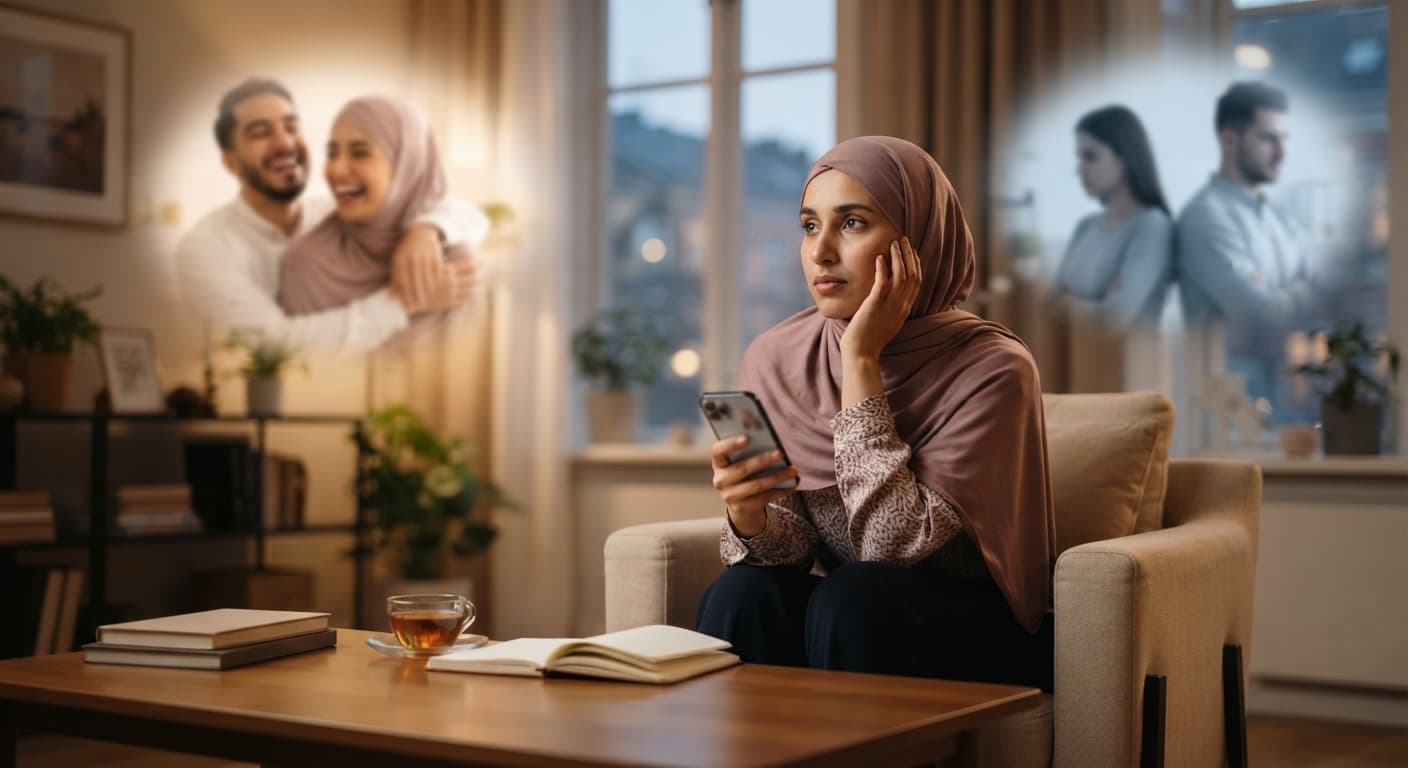
Almost all of his friends got married over the last two years, and the question became predictable at every family gathering: what about you? At first he'd laugh it off and change the subject, but as the question kept repeating, he started feeling real pressure, and began seriously considering marriage — not because he felt a clear inner desire, but because he was starting to fear being left behind. One day he stopped and asked himself a more honest question: am I ready for this step, or am I just afraid of being the only one left unmarried?
This difference between genuine readiness and reacting to outside pressure — social, age-related, or even an unexamined inner pressure — is exactly what's worth pausing on before making a decision this big. So what signs indicate real readiness, not just a desire to keep pace with everyone around you?
Readiness isn't an age or a job title
The first common mistake is tying readiness to a number: I turned thirty, so I should get married, or I got a stable job, so I'm ready. These indicators matter, but they aren't readiness itself. Someone at twenty-five might be more mature and more ready than someone at thirty-five who's never seriously thought about what it means to fully share their life with another person. Real readiness is an internal state, not an age or career milestone you automatically reach over time.
Sign one: wanting partnership, not escaping something
A very useful question to ask yourself: do I want marriage because I want to build a life with someone I share everything with, or because I want to escape loneliness, family pressure, or a sense of failure compared to my friends? The two motives can look similar from the outside, but the difference between them is fundamental: someone marrying in search of real partnership enters the relationship with a mindset of building together, while someone marrying to escape something carries that same emptiness into the marriage, and expects their partner to fill it — a burden no marriage can carry on its own.
Sign two: the ability to carry responsibility for another person
Readiness means an actual, not theoretical, ability to factor another person's needs into your daily decisions, not just your own. Someone who still can't organize their own time or handle simple personal commitments will struggle to carry a much bigger shared responsibility. This doesn't mean perfection in every detail, but it does mean a baseline of practical maturity: the ability to keep a commitment, manage a simple budget, and deal with a problem instead of running from it or leaving it for others to solve.
A practical example: a young man has lived alone for years, but still relies on his mother to cook his meals and organize his bills, and keeps postponing simple responsibilities until they pile up. This pattern doesn't suddenly disappear after marriage — it usually just transfers to the wife, who finds herself carrying the same role the mother used to, without anything changing in how the husband handles responsibility itself.
Sign three: emotional stability with yourself first
It's hard to give someone else emotional stability when you haven't achieved it with yourself yet. This doesn't mean you need to reach some perfect state of inner peace before marriage — no one gets there — but it does mean a reasonable awareness of your own emotions, and the ability to handle anxiety, sadness, or anger without the relationship collapsing at the first test. Someone who enters marriage carrying unresolved emotional wounds, or unrealistic expectations that their partner will fix everything inside them, places a burden on their partner they don't deserve — and that burden usually explodes later in disputes that don't seem connected to their real cause.
Sign four: the ability to compromise without losing yourself
Shared life requires small daily compromises — in decisions, in time, in how you spend vacations, and sometimes in bigger things like where you live or your general lifestyle. Someone who hasn't yet tested their ability to compromise without a constant feeling of loss or unfairness may struggle to adapt to this side of marriage. The good sign here isn't the absence of any reluctance to compromise — that's normal — but the ability to distinguish between a healthy compromise that serves the relationship and one that costs you something essential to your identity, without constantly confusing the two.
What if you feel unready on some of these signs?
That doesn't necessarily mean postponing the idea of marriage, because readiness isn't a fixed state a person either has or doesn't — it's a path that develops with awareness and self-work. Someone who recognizes they're lacking in a specific area, managing their emotions, for instance, and works on improving it, is closer to being ready than someone who believes they're prepared without any real reflection on their weak points. What matters is that this work is honest and realistic, not just a justification for postponing the decision indefinitely under the excuse of "not ready yet" every time a real test approaches.
A question many people ask: does this mean I have to wait until I'm perfect?
Not at all, and that's a common misunderstanding that pushes some people to postpone marriage indefinitely, searching for a flawless version of themselves that will never arrive. What's required isn't perfection, it's a reasonable level of maturity on each of the signs above, combined with genuine awareness of remaining weak points and a willingness to work on them within the relationship itself, not necessarily before it. Many successful couples weren't a hundred percent ready on their wedding day, but they were ready enough, and willing to keep growing together afterward.
Readiness alone isn't enough without the right person
It's important to note that all these signs speak to your own readiness, not the readiness of the relationship as a whole. Someone fully ready for marriage might still need extra time to find the right person, and that doesn't contradict their inner readiness. Confusing the two pushes some ready people to accept the first available opportunity just to prove their readiness to themselves or those around them, while real readiness also includes enough patience to wait for actual compatibility, not rushing simply because of the feeling of being ready. Is there a specific age someone is supposed to feel this readiness by? Readiness isn't tied to a fixed age — some people reach it at twenty-three, others need until thirty or later, without that meaning one group is better than the other; what matters is that the decision comes from real maturity, not social pressure or fear of falling behind, since someone who marries early because they're genuinely ready is completely different from someone who marries early out of fear of what people will say, even if their ages match exactly. A question worth asking yourself in the end: do you want to marry this specific person, or do you just want the idea of marriage in general?
In the end
Readiness for marriage isn't an age number or a reaction to repeated social pressure — it's an internal state that combines a genuine desire for partnership, a practical ability to carry responsibility, sufficient emotional stability, and flexibility in compromise without losing yourself. Whoever examines themselves honestly against these signs, rather than against the recurring "what about you?" at every family gathering, makes their decision from a far clearer place — whether the outcome is that they're ready, or that they need a bit more time to become so. And remember that this self-examination isn't a one-time test, but a healthy habit worth repeating periodically, because readiness itself shifts over time, experience, and maturity — what you weren't ready for a year ago, you may have already built the necessary foundation for now, without clearly noticing until you ask yourself directly. In any case, don't turn this self-examination into an added source of anxiety weighing on you — treat it instead as a tool that helps you understand yourself more clearly, whether it leads you toward a decision to marry soon, or toward a decision to work on yourself first before any new step. Both decisions represent real maturity when they're built on honest awareness rather than guesswork or outside pressure. And finally, share this self-examination with someone whose judgment you trust — a close friend or a wise family member — because sometimes others see clear patterns in us that are hard for us to see ourselves, no matter how honestly we try to look. In any case, remember that this question deserves your time and serious thought, not a quick answer given just to satisfy those around you or end a recurring family discussion. And in the end, real readiness often shows up in the calm with which you ask yourself these questions, not in the excessive anxiety that sometimes accompanies the search for a perfect answer that doesn't exist. And finally, don't forget that those around you, however wise, don't live the daily details of your life the way you do — the final decision remains yours alone in the end. And in the end, clarity with yourself today spares you a lot of regret tomorrow. And that clarity, when it comes from within you rather than pressure from those around you, stays with you far longer than anyone else might imagine. Take your time reaching it with complete honesty toward yourself, first and above everything else.
Put your standards in a real profile
Create your free account in the browser and let matching work on your criteria, not on photos.