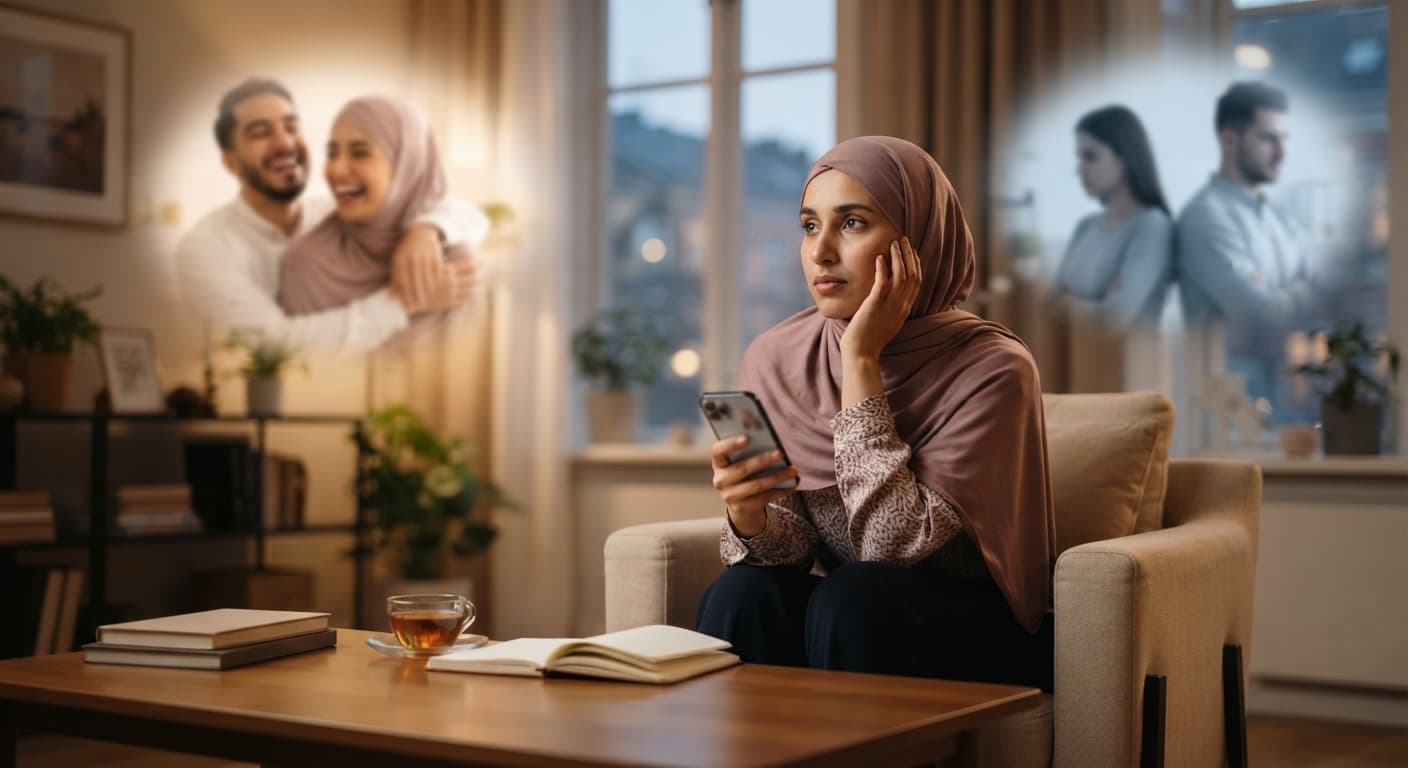
She has a master's degree from a well-known university; he finished vocational training and went straight into the job market a few years later. Everything between them is going strikingly well: they laugh at the same jokes, agree on most discussions, and each feels a depth of being understood by the other that they've rarely experienced with anyone before. But a question quietly worries her whenever she mentions her academic background to her friends: is this gap in degrees going to become a real gap between us over time, or am I afraid of something purely cosmetic that no one will care about a year or two into the marriage?
This worry is very common among many people who find themselves in a similar situation, because educational level is sometimes socially treated as a direct, reliable measure of intellectual compatibility between partners, when the reality is far more complicated than that once you look closely. A degree is an indicator of one specific thing: an academic path a person chose, or had access to, at one point in their life. But it isn't a direct indicator of depth of thought, level of maturity, or even the capacity for continuous growth. This doesn't mean formal education is worthless — it means its real effect on marital compatibility is largely indirect: it's a possible signal, not a guarantee, and what determines the quality of intellectual compatibility is what each person did with their intellectual life after their formal education ended, whatever level that education reached.
The difference between a degree and actual intellectual level
There are plenty of people with the highest academic degrees and titles whose conversation stays shallow outside their narrow specialty, and there are, just as often, people who never finished university at all but are voracious readers, informed on a wide range of topics, and capable of deep, enjoyable discussion on almost anything put in front of them. A degree tells you someone completed a specific academic path at a specific time, but it doesn't necessarily tell you about their current intellectual curiosity, or their desire to keep learning and growing — and those two things matter far more than the degree itself when it comes to long-term intellectual compatibility between partners. Which is why we sometimes find a couple — one with a PhD, the other who only finished high school — living an intellectual compatibility that plenty of people who graduated from the same college would envy, because what connects them isn't a similar academic path, but a similar curiosity and desire to understand.
When is an education gap just a detail that doesn't matter?
When both people are capable of real intellectual connection despite their different academic paths: they enjoy discussing ideas together, each respects the other's interests even when they don't share them, and neither feels superior or inferior because of a degree. In this case, the education gap becomes just a line in a CV, not a factor that affects the quality of daily life together. Many successful marriages bring together partners from different educational backgrounds, because what connected them was a deeper alignment in thinking and values than any degree could measure. A real-world example: a female engineer with an advanced degree married a man working in a skilled trade with no university degree at all, and when later asked about the secret to their compatibility, she said their evening conversations about books, ideas, and everyday situations run far deeper than any conversation she ever had with her old university classmates — simply because he's a curious person who reads, asks questions, and keeps thinking.
When does an education gap become a real gap?
The real problem doesn't come from the education gap itself, but from a gap in intellectual curiosity and the desire for continuous growth. When one person stops reading, learning, and staying informed altogether, while the other keeps developing themselves intellectually, a real gap widens between them over the years — not because of the original degree, but because of how differently their paths diverged afterward. It also becomes a real issue when one person feels superior to the other because of their degree, or when the other person feels a constant sense of inadequacy that stops them from participating confidently in discussions. That's when an education gap stops being a cosmetic detail and turns into a genuine source of emotional tension worth paying attention to. This tension often builds quietly: the person who feels superior might not intend to insult anyone, but their repeated tone of correcting the other or unintentionally dismissing their opinion leaves a cumulative mark, while the other person may start avoiding discussions they used to enjoy, just to avoid that recurring feeling of inadequacy.
Reading and continuous intellectual growth: a more accurate measure than a degree
The more important question isn't "what's his degree?" but "is he still learning and growing intellectually?" Someone who reads consistently, follows topics they care about, and keeps developing their skills and knowledge despite not holding an advanced formal degree is often a more intellectually enriching life partner than someone who stopped learning the day they graduated. This is something that needs real observation over time: how do they spend their free time? Do they get excited about new topics, or stick only to what they already know? Do they ask questions and look for answers, or settle for ready-made opinions? Noticing these habits doesn't require a formal test — just simple attention during the months of getting to know each other: do they share an article they liked? Do they ask your opinion on a book or a new idea they came across? Do they get excited to try something they've never encountered before, or do they always prefer staying within the boundaries of what they already know, with no real attempt to expand it?
The education gap's effect on everyday conversation
A significant part of married life rests on the ability to talk together deeply — not just about daily logistics, but about ideas, opinions, and expectations from life. When there's a real gap in the capacity for this kind of conversation, whatever its cause, one person starts to feel like they're talking to themselves or constantly simplifying their thoughts just to be understood, while the other sometimes feels shut out of discussions they can't confidently take part in. This tension isn't directly about the degree — it arises when there's a real gap, left unaddressed with any awareness, in intellectual maturity and ongoing curiosity between the two people. The solution here isn't necessarily for one person to change into a copy of the other — it's for both to find genuine shared spaces where they enjoy deep conversation, even if those spaces differ from each of their original interests, alongside mutual respect for the spaces they don't share to the same degree.
How do you actually assess this aspect?
Instead of treating a degree as the final word, it's far more useful to notice: do we enjoy talking together about things outside daily logistics? Does he respect my interests even when he doesn't share them? Does he show curiosity toward new things, or does he seem content with what he already knows? Do I feel like I can discuss anything that matters to me with him without constantly simplifying what I say? The answers to these questions give you a far more accurate picture of your real intellectual compatibility than the degrees hanging on the wall ever could. The question worth asking yourself isn't "does his degree match mine?" but "do I feel like I'm growing intellectually alongside him, or do I feel like I'm standing still while he's standing still too?" An honest answer to that specific question reveals real intellectual compatibility far more than comparing two degrees hanging on two different walls.
Do public opinion and family overestimate this gap?
Often, yes. Many families link a university degree to a certain social status, worrying about an education gap as a sign of a broader class divide rather than a sign of actual intellectual compatibility, a concern that's socially understandable but often confuses two different things: social status and intellectual level. Someone from a modest background can be intellectually deeper and more well-read than someone from a prestigious background who stopped reading years ago — much like two graduates who leave the same college with the same grade, but one stops reading and learning entirely after graduation while the other keeps growing in different areas, even though their diplomas say the exact same thing on paper; compare them five years later and you'll find a real gap in how they think and talk despite identical formal credentials. This is why the question deserves more depth than simply checking a university's name or the grade on a certificate, and it also helps to notice how someone talks about subjects outside their own field — genuine curiosity about new topics says a lot about their future mindset. It also helps to notice how someone reacts to a new piece of information they don't already know: do they meet it with curiosity and a wish to understand, or dismiss it to protect their image in front of you? That small detail reveals a mind open to learning, or closed to it, completely apart from any formal degree they hold.
In the end
Formal education level isn't, on its own, a sufficient standard for judging real intellectual compatibility between partners, nor is it something that can be dismissed without examining its actual effect on the relationship. What matters more than the number on a degree is ongoing intellectual curiosity, the ability to grow together, and mutual respect for different interests. Someone searching for intellectual compatibility sometimes finds it with a person who graduated with honors, and other times with someone who took a different path but never once stopped learning and staying curious about the world around them.
Put your standards in a real profile
Create your free account in the browser and let matching work on your criteria, not on photos.